Mathematical Modeling of the Molybdenum Blue Production from Serratia sp. strain DRY5
DOI:
https://doi.org/10.54987/jemat.v8i2.565Keywords:
molybdenum reduction; molybdenum blue; bioremediation; modelling; Serratia sp.Abstract
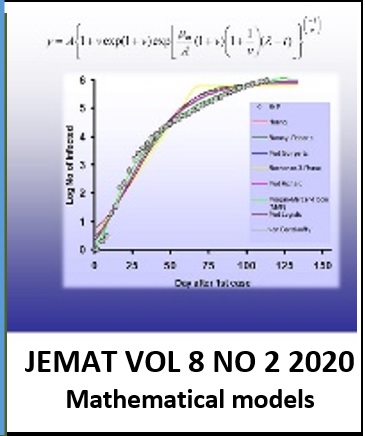
The reduction of molybdenum to molybdenum blue is a detoxification process and the development of Mo-blue is associated with growth. Significant parameters such as precise reduction rate, theoretical maximum reduction and whether reduction at high molybdenum concentration influenced the lag time of reduction can be discovered by mathematical modeling of the reduction phase. While common, the use of the linearization method by the use of natural logarithm transformation is inaccurate and can only provide an approximate value for the calculated single parameter, the real growth rate. In this work, a variety of models for such as logistic, Gompertz, Richards, Schnute, Baranyi-Roberts, Von Bertalanffy, Buchanan three-phase and more recently Huang were utilized to obtain values for the above parameters or constants. The Huang model was the best model in modelling the Mo-blue production curve of the Serratia sp. strain DRY5 based on statistical tests such as root-mean-square error (RMSE) (0.043), adjusted coefficient of determination (R2) (0.994), bias factor (BF) (1.00), accuracy factor (AF) (1.03) and corrected AICc (Akaike Information Criterion) (-67.02). Parameters obtained from the fitting exercise were maximum Mo-blue production rate (ïm), lag time (ï¬) and maximal Mo-blue production (Ymax). We make use of primary growth models for modeling Mo-blue output in this work. This is an emerging method of identifying constants of parameters that control the reduction of molybdenum. For the creation of further secondary models, the constants calculated from this work will be utilized for such purpose. The use of these primary models can also be broadened to processes involving the detoxification of other heavy metals.
Downloads
Published
Issue
Section
License
Authors who publish with this journal agree to the following terms:
- Authors retain copyright and grant the journal right of first publication with the work simultaneously licensed under a Creative Commons Attribution License (http://creativecommons.org/licenses/by/4.0) that allows others to share the work with an acknowledgement of the work's authorship and initial publication in this journal.
- Authors are able to enter into separate, additional contractual arrangements for the non-exclusive distribution of the journal's published version of the work (e.g., post it to an institutional repository or publish it in a book), with an acknowledgement of its initial publication in this journal.
- Authors are permitted and encouraged to post their work online (e.g., in institutional repositories or on their website) prior to and during the submission process, as it can lead to productive exchanges, as well as earlier and greater citation of published work (See The Effect of Open Access).